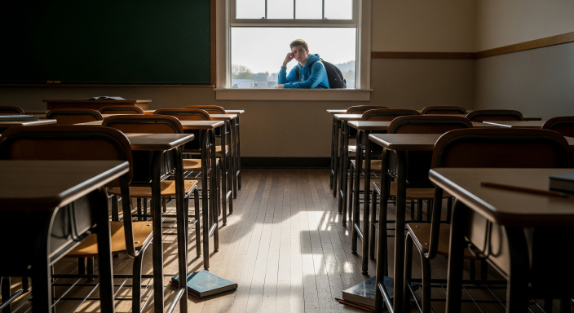

The hallways are quieter, and thousands of desks remain empty across America. The issue of pandemic missing students has spiraled into a national emergency, leaving educators scrambling for answers. New data analysis reveals that nearly 240,000 children have vanished from the public school system in 21 states alone, a figure that does not account for private transfers or homeschooling. This phenomenon of pandemic missing students threatens to create a “lost generation,” disconnected from the safety net of education and social support.
Lives Interrupted: Families Struggle with the Missing Student Crisis
It isn’t just data; it is real lives interrupted by chaos. For students like Kailani Taylor-Cribb from Cambridge, Massachusetts, the disconnection was gradual but absolute. After the pandemic shuttered her high school, the isolation of Zoom classes became unbearable. Like many pandemic missing students, she traded the classroom for a paycheck, working shifts at Chipotle to support her family.
Her story mirrors thousands of others—teens forced to choose between survival and algebra, effectively dropping off the educational radar. While Kailani eventually re-enrolled with the help of a dedicated social worker, many others remain drifting, their academic futures paused indefinitely.
Vulnerable Demographics Hit Hardest
While the decline is broad, specific groups are suffering most. The data indicates that the population of pandemic missing students is disproportionately composed of low-income children and kindergarteners who never started school. Without early intervention, these youngest learners risk permanent academic setbacks, widening the achievement gap that existed long before the virus struck.
The Scale of Devastation: 240,000 Unaccounted Children
The sheer volume of this exodus is staggering. An exhaustive analysis of enrollment data across 21 states and Washington D.C. exposes the depth of the pandemic missing students problem:
- 240,000 students are completely unaccounted for—they did not move to private schools or register for homeschooling.
- 710,000 students left public schools in these states overall between the 2019 and 2022 school years.
- California alone lost over 150,000 students from enrollment rolls.
- Census data confirms the school-aged population did not shrink enough to explain these empty seats.
Why the System Failed to Track the Missing
How does a child simply vanish from the system? The chaos of COVID-19 exposed deep flaws in how states track attendance. As families moved due to economic instability or housing insecurity, school districts lost contact. This lack of centralized data contributed significantly to the rise in pandemic missing students.
Unlike standard transfers, these children fell into a “ghost” category. Antiquated tracking systems failed to flag their absence until months or years had passed. This represents a systemic failure to protect the most vulnerable during a global crisis, as schools acted not just as centers of learning, but as hubs for nutrition and counseling.
The Shift to the Workforce
For older students, the allure—or necessity—of the workforce was a major pull factor. With schools closed, many teenagers took full-time jobs to help struggling parents pay bills. Once the paycheck started coming in, returning to a structured school environment became increasingly difficult, swelling the ranks of the missing.
From Crisis to Resilience: Schools Fight to Recover the Lost
The recovery phase has begun, but it requires aggressive and compassionate action. School districts are now employing “door-knocking” campaigns and hiring dedicated social workers to locate pandemic missing students. The goal is not punishment for truancy, but support—offering flexible schedules, credit recovery programs, and mental health resources.
If the education system is to recover, it must pivot from passive enrollment to active engagement. Communities are rallying, understanding that bringing these students back is essential for the long-term health of society.
Conclusion
The mystery of the pandemic missing students is a wake-up call for the American education system. While some, like Kailani, have found their way back, thousands remain in the shadows. We must acknowledge that every number in that 240,000 estimate represents a child’s future currently on hold. Addressing the pandemic missing students crisis is not just about filling seats; it is a moral imperative to restore hope to a generation disrupted by historic circumstances.