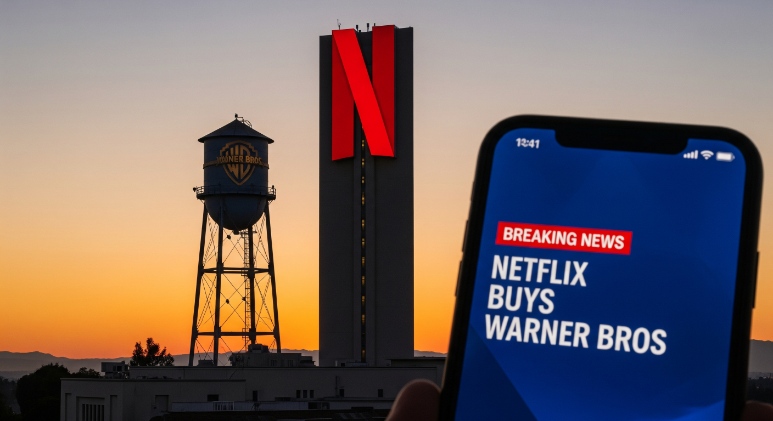

Netflix acquires Warner Bros in a move that has fundamentally shattered the entertainment landscape, marking the most significant consolidation in Hollywood history. On Friday, the streaming giant announced a definitive agreement to purchase the legendary studio for a staggering $82.7 billion, signaling the end of the traditional media era and the dawn of a new super-streamer. As news of the Netflix acquires Warner Bros deal spreads, industry insiders and subscribers alike are reeling from the shock of seeing the “House of Mouse” rivaled by a new “House of Netflix.”
Hollywood Shaken: Studios Merge in Historic Shift
The entertainment world is grappling with an unprecedented reality: the Netflix acquires Warner Bros agreement places 100 years of cinema history under the banner of the company that invented streaming. For the first time, the studio behind Casablanca and The Dark Knight will be owned by a tech-native platform.
This isn’t just a business transaction; it is a cultural earthquake. “Survivors” of the streaming wars—smaller platforms and traditional cable networks—are now facing a juggernaut that combines Netflix’s massive global reach with Warner Bros.’ prestigious content library. While fans celebrate the potential of seeing Game of Thrones and Stranger Things on the same app, thousands of industry creatives are expressing concern over the shrinking number of buyers for their work.
DC Universe and HBO Join the Fold
The immediate impact will be most visible in content libraries. Netflix acquires Warner Bros assets including the entire DC Universe, the Wizarding World of Harry Potter, and the crown jewel: HBO. This means iconic series like The Sopranos and Succession will eventually migrate to Netflix, creating an unrivaled content fortress that competitors may find impossible to breach.
The Scale of Devastation: $82.7 Billion Takeover
The data behind this acquisition reveals the sheer magnitude of the merger. The Netflix acquires Warner Bros deal is not just big; it is record-breaking.
- $82.7 billion total enterprise value, including debt assumed by Netflix.
- $27.75 per share valuation for Warner Bros. Discovery stock, a significant premium.
- Q3 2026 is the targeted closing date for the transaction.
- $2 billion in estimated annual cost synergies expected within the first three years.
This financial maneuver effectively splits the current Warner Bros. Discovery entity. While Netflix takes the studios and streaming assets, the linear TV assets—including CNN and TNT Sports—will be spun off into a new independent company, “Discovery Global.”
Streaming Wars: Why Netflix Made the Move
Contextualizing why Netflix acquires Warner Bros now requires looking at the brutal economics of the “streaming wars.” For years, analysts warned that the market was oversaturated. Netflix, despite its dominance, faced slowing growth in mature markets and fierce competition from Disney+ and Amazon Prime.
By purchasing Warner Bros., Netflix solves its two biggest problems: a lack of historic IP and the constant need to spend billions producing new hits. This move exposes the vulnerability of legacy studios that struggled to pivot to digital. Warner Bros. Discovery, burdened by debt from previous mergers, found itself unable to compete purely on subscriber growth, making this acquisition a necessary, albeit shocking, evolution.
Regulatory Hurdles Ahead
The deal is far from done. Experts warn that the Netflix acquires Warner Bros merger will face intense scrutiny from antitrust regulators in the US and EU. With a consortium of “concerned feature film producers” already petitioning Congress, the road to closing in 2026 will be paved with legal challenges regarding market monopoly.
From Crisis to Resilience: What Comes Next?
As the dust settles, the focus turns to the future of entertainment. The Netflix acquires Warner Bros deal promises a streamlined experience for consumers, who may finally see a reprieve from “subscription fatigue” as content aggregates under one roof.
For the industry, the path forward is one of adaptation. Netflix Co-CEO Ted Sarandos has pledged to maintain the Warner Bros. theatrical release model, attempting to assuage fears that cinemas are dead. However, as the lines between “cinema” and “content” blur, the creative community must prepare for a new reality where one gatekeeper holds the keys to the world’s most valuable stories.
CONCLUSION
The news that Netflix acquires Warner Bros is more than a headline; it is the final curtain call for the Hollywood of the 20th century. As we look toward 2026, the industry faces a future defined by this monumental consolidation. Whether this leads to a golden age of content or a stifling monopoly remains to be seen, but one thing is certain: the streaming wars are over, and Netflix has claimed the ultimate prize.