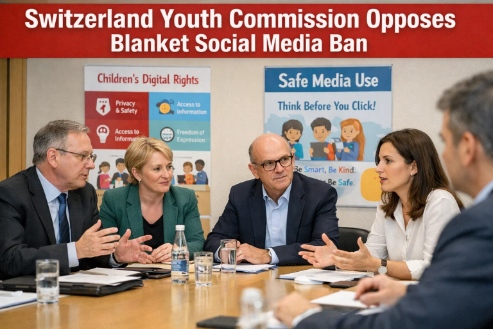

The Switzerland social media ban debate has taken a balanced turn as the Federal Children and Youth Commission (FCYA) formally opposed a general ban on social media for children, emphasizing both protection and digital rights. While fears over online risks continue to grow across Europe, Swiss authorities are now weighing whether restrictive laws are the right solution for minors. In its position paper, the commission underscored that outright platform bans may inhib it children’s access to information, education and participation just as much as they aim to protect them. This stance adds nuance to ongoing discussions about digital safety and youth empowerment.
Youth Commission Rejects Blanket Social Media Ban in Switzerland
The Switzerland social media ban proposal has triggered debate within political and educational circles, but the Federal Commission for Children and Youth Affairs (FCYA) has taken a clear stand against general prohibitions. In a position paper released in November 2025, the commission argued that a blanket ban would unnecessarily restrict the ability of children and parents to act in their own best interests, and could conflict with children’s rights outlined in the UN Convention on the Rights of the Child.
The FCYA proposes that safe and age-appropriate usage guidelines be co-developed with children and young people, rather than imposing a top-down ban that could limit learning opportunities and engagement with digital culture.
Rights at Stake — Protection vs Participation
The commission highlighted that alongside protection, young people also have a right to access information, education and digital participation, all of which can be facilitated through thoughtful digital policy rather than simple prohibition. Supporters of the FCYA stance believe that education, media literacy and structured guidance may better equip children to navigate online spaces safely.
The Broader Switzerland Social Media Ban Debate
The discussion over restricting youth access to social platforms is part of a wider national conversation about online safety and child welfare:
- Surveys indicate strong public concern — with around 80 % of Swiss adults supporting bans for under-16s in recent polls.
- Local canton policies — such as Nidwalden’s ban on phones and digital devices in schools — already reflect steps toward limiting exposure.
- Other voices, including school leaders and parent advocacy groups, strongly argue for tougher limits due to addiction and mental health concerns.
This complex landscape shows how lawmakers and communities are grappling with the balance between children’s rights and digital protections.
Why the Commission’s Stance Matters
The FCYA’s position injects critical perspective into what might otherwise be a one-dimensional policy debate. By rejecting blanket bans and urging inclusive guideline development, the commission places emphasis on education and consent rather than restriction alone. This distinguishes Switzerland’s debate from more unilateral models, such as Australia’s move to ban under-16s from platforms — a policy that has drawn mixed reactions worldwide.
The FCYA also supports involving children and youth directly in creating digital use frameworks, aiming to build skills that help them recognize, classify and engage constructively with online content — a holistic approach to digital literacy and safety.
Perspectives from Around Switzerland
While national bodies weigh in with policy perspectives, individual cantons are already experimenting with rules in their schools — for example, Solothurn allowing each school to decide on its own social media or phone policies. This grassroots approach reflects varying community priorities and attitudes toward technology, learning, and regulation.
Looking Ahead — Policy and Participation
The Switzerland social media ban debate is set to continue into 2026 as lawmakers, educators and civil society groups refine their positions. With surveys showing significant public worry about online harms but expert groups cautioning against outright bans, future policy may emphasize digital education, platform regulation and age-verified safeguards. The FCYA’s stance may help shape this dialogue by insisting that children’s rights and voices remain central to any policy outcome.
Conclusion
Switzerland’s social media ban discussion has evolved into a nuanced public policy debate that pits protection against participation. The Children and Youth Commission’s clear opposition to a blanket ban underscores the importance of balancing safety with children’s rights to information, education and digital engagement. Rather than restricting access outright, Swiss policymakers may gravitate toward educational, regulatory and participatory approaches that empower young people to navigate online spaces responsibly. As this debate unfolds into the New Year, Switzerland’s careful, rights-informed strategy could become a model for other nations wrestling with similar questions about children and technology.