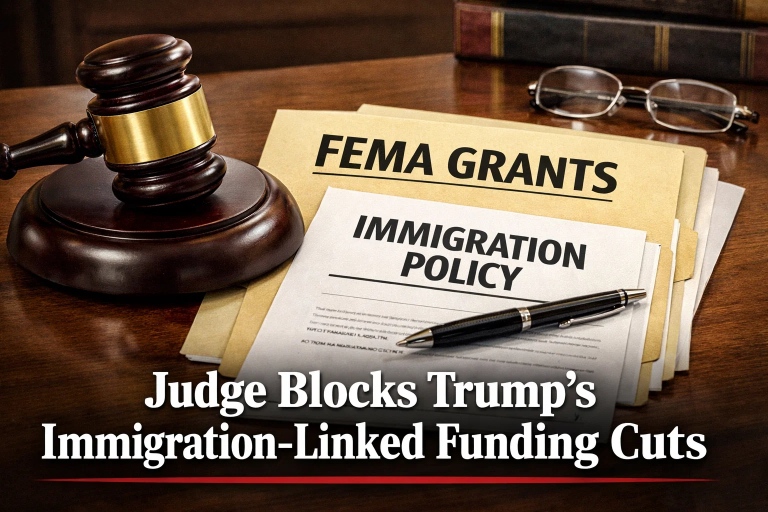

The immigration funding dispute between the Trump administration and several U.S. states reached a critical legal turning point as a federal judge in Rhode Island ordered the restoration of over $233 million in federal disaster and Homeland Security grant funding that had been withheld from states citing “sanctuary” policy disagreements. The judge found the administration’s actions arbitrary and politically motivated, rejecting the conditioning of vital emergency funds on cooperation with federal immigration enforcement. This divisive federal ruling not only affects state budgets for disaster response but also highlights deep national tensions over immigration policy and federal-state relations.
Judge Orders Restoration of Cut FEMA and Homeland Security Grants
In her decision, U.S. District Judge Mary McElroy ruled that the Trump administration’s move to reduce funds for states that declined to align with federal immigration enforcement policies violated established legal standards and grant rules. The withheld funds were part of disaster and Homeland Security aid allocations intended to support local emergency preparedness, first responder capabilities and community safety. The states involved — including New York, Massachusetts and Washington — argued that these cuts were imposed as punishment for their sanctuary policies, which limit cooperation with federal immigration authorities.
What’s at Stake for Local Services
Federal disaster and Homeland Security grant money helps pay for training, emergency communications, equipment and first responder support — crucial for effective disaster preparedness. When such funding is withheld, local agencies may face delays or reductions in critical services. State officials say the uncertainty created by tying aid to immigration cooperation could leave communities less prepared for emergencies.
Details of the Immigration Funding Dispute
Here’s a snapshot of what the ruling addressed:
- $233 million+ — funding that must now be restored to states.
- 12 states — including major Democratic-led states targeted for cuts.
- Funds drawn from FEMA and Homeland Security grant programs.
- Judge found the cuts arbitrary, capricious and politically motivated rather than based on risk or need.
- Administration planning an appeal of the decision.
These facts frame the dispute not as a purely technical issue but as a broader test of how far federal policy can be tied to immigration cooperation.
Why This Ruling Matters — Federalism and Funding Fairness
The immigration funding dispute draws on long-standing constitutional and administrative law ideas: federal grants must be distributed according to law and consistent criteria, not as punishment for policy disagreements. Grant programs like those managed by FEMA are designed around objective threat and vulnerability assessments, not political alignment with national immigration enforcement. The judge’s ruling reinforces that funds meant for emergency response cannot be withheld based on unrelated policy compliance. Critics of the Trump administration’s approach argue that tying disaster funding to immigration cooperation undermines public safety and jeopardizes communities’ ability to respond to disasters.
A Broader Pattern — Immigration and Federal Funding Battles
This conflict is part of a wider set of legal fights over the Trump administration’s attempts to link immigration enforcement and federal funding decisions, including past cases preventing cuts to “sanctuary cities” and rulings that federal authorities can’t condition certain disaster programs on immigration cooperation.
What Happens Next — Appeals and Political Pushback
The Trump administration has signaled it will appeal the judge’s ruling, setting up a prolonged legal and political battle over federal executive authority and state autonomy. Supporters of the administration’s policy see conditioning funds as a legitimate enforcement tool to promote cooperation, while opponents see it as coercive overreach that threatens effective disaster management and the separation of powers. Meanwhile, state officials and Democratic leaders have praised the court’s decision as a necessary check on federal authority.
Conclusion
The immigration funding dispute ruled by a federal judge underscores the complex interplay between immigration enforcement policy and critical emergency funding in the United States. By blocking the Trump administration’s attempt to tie disaster and Homeland Security grants to states’ cooperation with federal immigration authorities, the court reaffirmed legal limits on conditional funding and protected vital resources for disaster preparedness. As the administration moves toward an appeal, the conflict promises to remain a flashpoint in U.S. political and legal debates over federal power, state autonomy and the balance between immigration policy and public safety funding.