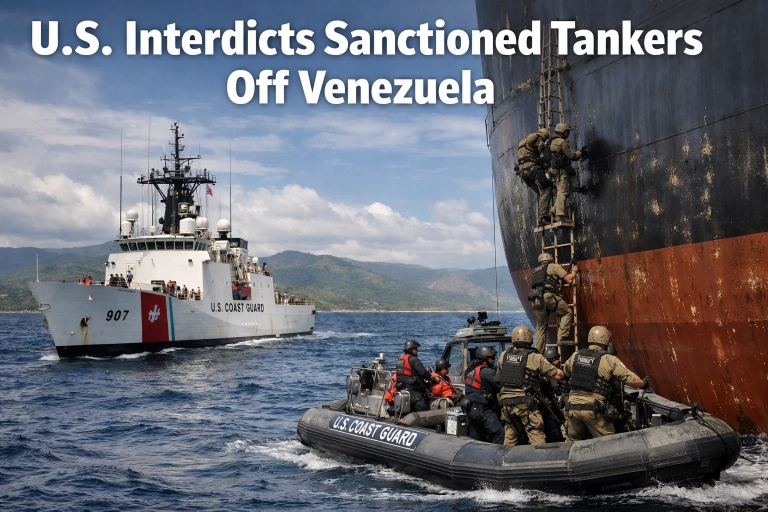

The U.S. intercepts sanctioned vessel in a controversial move off Venezuela’s coast, marking a significant escalation in Washington’s enforcement of sanctions and pressure campaign against President Nicolás Maduro’s government. U.S. officials confirmed that the Coast Guard is interdicting and seizing a tanker suspected of moving sanctioned Venezuelan oil in international waters, intensifying operations this month after another tanker — Centuries — was stopped carrying nearly 1.8 million barrels of Venezuelan crude. The action follows an unprecedented order for a “total and complete blockade” on sanctioned oil tankers, raising legal and diplomatic disputes with Caracas and global partners over maritime law and sovereignty.
U.S. Intercepts Sanctioned Vessel in International Waters
In the latest U.S. enforcement action, Coast Guard assets — with logistical support from other U.S. agencies — moved to interdict a sanctioned vessel believed to be part of a “shadow fleet” used to evade Venezuelan sanctions. U.S. officials, speaking on condition of anonymity, explained that the vessel was sailing under a false flag and was subject to a judicial seizure order before U.S. forces approached it in international waters near Venezuela’s coast. This would be the second tanker interdicted in recent weeks under the same operational campaign, highlighting an ongoing, broader strategy to cut off revenue streams linked to Caracas.
What Is a “Shadow Fleet”?
“Shadow fleet” refers to networks of oil tankers that reportedly operate with falsified shipments, transponders disabled or under misleading flags to mask sanctioned trades. The U.S. government and maritime analysts have increasingly linked such vessels to revenue flows that may benefit sanctioned regimes and proxy groups, though critics argue the legal justification and transparency of evidence in some cases remain unclear.
The Numbers Behind the Interceptions
Here’s a snapshot of U.S. maritime sanctions enforcement off Venezuela:
- ~1.8 million barrels — crude carried on the Centuries tanker seized after departing Venezuela’s José Terminal.
- Multiple tanker seizures — at least two interdictions in December 2025.
- Third interception attempt — U.S. Coast Guard actively pursuing another oil tanker flagged as part of sanctions evasion.
- U.S. naval buildup — warships and aircraft carriers deployed as part of strategic pressure campaigns in the Caribbean.
These figures underscore the scale and resources being mobilised by Washington in the oil blockade and sanctions enforcement campaign.
Why This Matters — Oil, Sanctions and Geopolitics
The interception of sanctioned vessels is tied to the U.S. effort to diminish Venezuela’s revenue sources — primarily oil — amid longstanding sanctions that intensified under the Trump administration’s policy of “maximum pressure.” By targeting shipping networks and tankers in international waters, the U.S. intends to choke off funds that might sustain Maduro’s government or associated networks, including what it calls narco-terrorism financing. Washington has also framed these operations within a wider context of countering criminal networks in the region. Reuters
The actions have ripple effects on global energy markets, Venezuelan export capacity and diplomatic relations with third countries involved in oil trade, particularly China, which is a major destination for Venezuelan crude.
International and Venezuelan Responses
Caracas immediately condemned the vessel interceptions as “international piracy” and theft, decrying the U.S. actions in strong terms and warning of legal and political counter-measures. Venezuela’s National Assembly passed new laws imposing punishments of up to 20 years in prison for perceived acts of piracy and blockades — a direct legislative response to U.S. operations.
Venezuela has signalled it will pursue complaints before the United Nations and other international bodies, asserting that the U.S. is disrupting lawful maritime commerce and violating sovereignty. These disputes are drawing wider scrutiny from global powers and regional partners, complicating diplomatic efforts and heightening tensions.
Strategic and Legal Debate
Experts and critics question the legal grounding of such interceptions under international law, particularly the extent to which a coastal state or extraterritorial law enforcement can act without explicit multilateral mandates. Some argue that the U.S. actions may set complex precedents for maritime sanctions enforcement, especially when intercepting vessels not explicitly listed on formal sanctions registers. Conversely, supporters argue that existing judicial orders and U.S. laws provide necessary instruments to pursue illicit sanctions evasion. These competing interpretations reflect deep legal and policy debates in the era of economic coercion.
Conclusion
The U.S. intercepts sanctioned vessel off the Venezuelan coast signal not only a tactical escalation in Washington’s sanctions enforcement but also a flashpoint in international maritime and diplomatic relations. By interdicting and seizing tankers tied to Venezuela’s sanctioned oil exports, the U.S. aims to squeeze revenue sources and pressure President Nicolás Maduro’s regime — a strategy that has drawn fierce condemnation from Caracas and prompted legislative countermeasures. As Washington and Caracas clash over the legality and consequences of these operations, the situation highlights how energy geopolitics and sanctions enforcement are reshaping regional dynamics in the Americas.