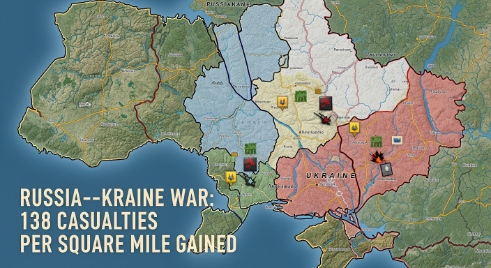

The Russia-Ukraine war losses have reached a devastating and critical threshold, according to a Newsweek analysis of a daily assessment by the Institute for the Study of War (ISW). The think tank found that during intensified offensive operations from September through November 2024, Russian forces suffered approximately 138 troop casualties for every square mile of territory they gained in Ukraine’s Donetsk Oblast — a stark measure of how costly incremental advances have become. These staggering loss figures intensify doubts about the Kremlin’s ability to sustain its military campaign, even as Moscow continues limited territorial gains in eastern Ukraine.
ISW Reveals Russia-Ukraine War Losses at High Cost
The Russia-Ukraine war losses reveal a grim picture of battlefield attrition for Moscow’s military. The Institute for the Study of War reported that Russian forces incurred around 125,800 casualties — including killed, wounded, and missing personnel — while gaining roughly 2,356 square kilometers (about 909 square miles) of Ukrainian territory during a three-month surge of operations in late 2024. That casualty-to-gain ratio equates to roughly 138 Russian troop losses for each square mile captured, underscoring how costly limited advances have been for the Kremlin’s offensive.
Tactical Gains With Heavy Price
Despite heavy personnel losses, Russian troops achieved small tactical advances near strategic eastern Ukrainian towns such as Toretsk, Pokrovsk and Kurakhove, but these gains came at an unsustainable human and logistical cost, according to the same assessment.
The Numbers Behind Russia-Ukraine War Losses
Here’s a breakdown of the Russia-Ukraine war losses in recent months:
- 125,800 estimated Russian casualties during intensified operations (Sep–Nov 2024).
- 2,356 sq km (909 sq mi) gained in the same period.
- ~138 casualties per square mile of ground gained.
- Ongoing personnel depletion adds pressure on Russia’s limited recruitment pool, complicating future manpower sustainability.
These figures reflect not just battlefield dynamics but also systemic strains on Russia’s military apparatus as the conflict enters its fourth year.
Why This Matters — High Casualties, Strategic Strain
The Russia-Ukraine war losses are significant because they highlight the attritional nature of the conflict and its immense human cost. High casualty rates strain military resources and morale, making large-scale offensive operations increasingly difficult to sustain without long-term shifts in strategy or mobilization policies. Russian manpower limitations — including competing demands between military service and the domestic economy — complicate Moscow’s ability to replace losses without deeper societal pressure.
At the same time, Kyiv and its Western allies emphasize the importance of continued military support to help Ukrainian forces maintain defensive and counteroffensive capabilities under intense pressure. Continued Western aid has been tied not just to battlefield defense but to broader diplomatic efforts aimed at stabilizing the war’s trajectory.
Human Toll and Broader Impact
Beyond operational metrics, these losses underscore the human toll of the Russia-Ukraine war, affecting soldiers, families, and communities on both sides. Total casualty estimates vary widely, but independent assessments suggest hundreds of thousands of military and civilian deaths and injuries since the February 2022 invasion — making this one of the deadliest European conflicts in decades.
Conclusion
The Russia-Ukraine war losses documented by the Institute for the Study of War reveal a sobering tableau: 138 Russian casualties for every square mile gained in parts of Ukraine’s Donetsk region — a measure of both the brutal human cost and diminishing returns of Moscow’s military strategy. These figures highlight the attritional nature of the conflict and underscore persistent doubts about Russia’s ability to sustain offensive operations in the long term. As the war grinds on and Western military aid continues to shape battlefield dynamics, the huge human and strategic costs on all sides remain a central feature of this devastating conflict.