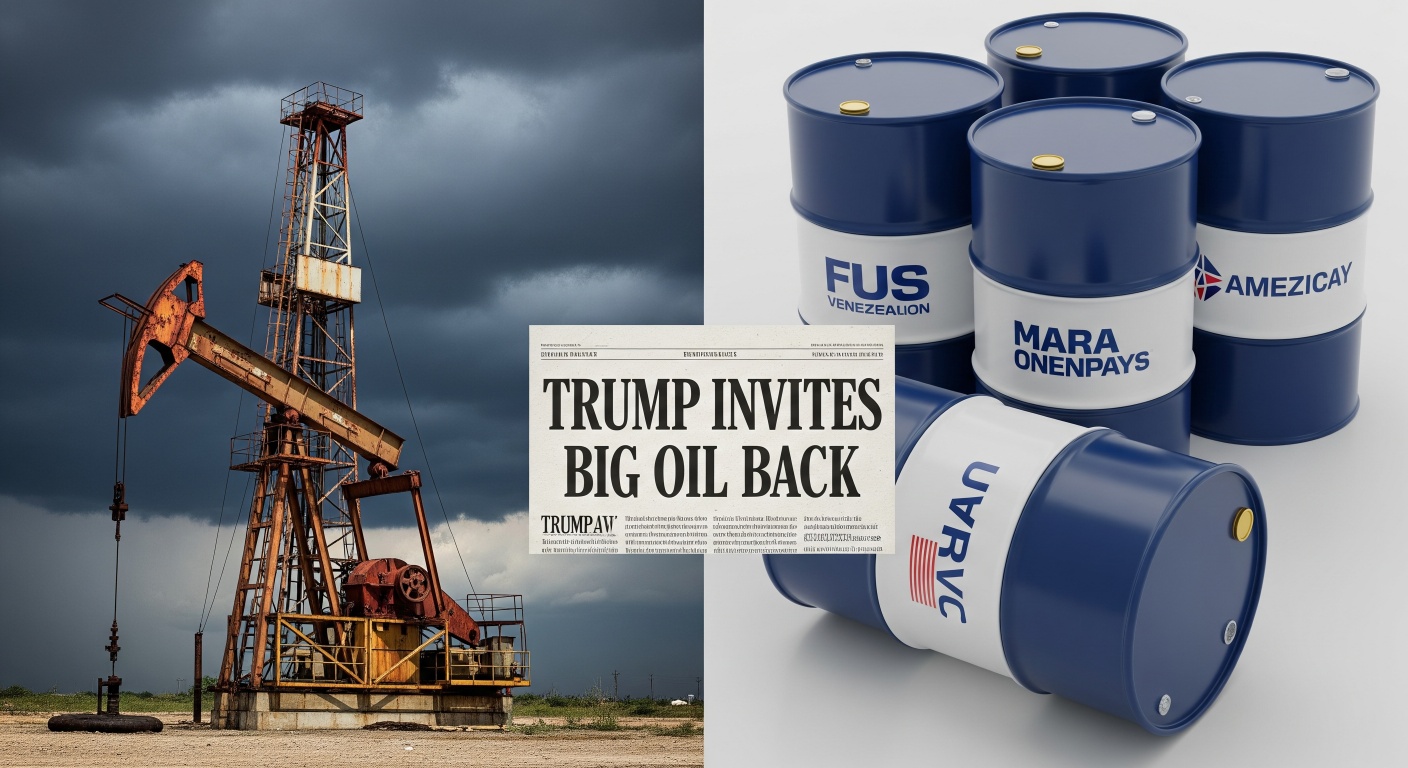

In a move that could reshape the global energy map, President Donald Trump has issued a direct call for US oil companies in Venezuela to reclaim their former dominance. Following the stunning US military operation that resulted in the capture of Nicolás Maduro just days ago, the President declared that American energy giants must “go in, spend billions,” and fix the broken infrastructure. This aggressive push to bring US oil companies to Venezuela marks a pivotal moment, aiming to reverse decades of socialist policy and restore production in a nation holding the world’s largest proven oil reserves.
Big Oil’s Hesitation: Once Bitten, Twice Shy
While the White House projects confidence, the boardrooms of Houston are reacting with calculated caution. For executives at ExxonMobil and ConocoPhillips, the prospect of returning to the Orinoco Belt is fraught with bitter memories. The industry is currently grappling with a “wait and see” approach, weighing the President’s security guarantees against the ghost of past asset seizures.
“We are monitoring the situation,” read a terse statement from ConocoPhillips, a sentiment echoed silently across the sector. The hesitation isn’t just about politics; it’s about trust. These corporations spent decades building Venezuela’s energy backbone only to be unceremoniously evicted. Asking them to pour capital back into a country that is currently under interim US military administration is a high-stakes request that goes beyond standard business risk.
The “Stolen” Assets Narrative
President Trump’s rhetoric strikes a specific chord with these executives. “We built it, they stole it,” he argued at Mar-a-Lago, referring to the billions in technology and infrastructure seized by the Venezuelan state. By framing the return of US oil companies to Venezuela as a reclamation of stolen property, the administration is attempting to turn a geopolitical crisis into a matter of corporate justice.
The Numbers: World’s Largest Reserves in Ruin
The economic case for returning is theoretically undeniable, but the data reveals the colossal scale of the challenge. The disconnect between potential and reality is stark:
- 303 Billion Barrels: Venezuela holds the largest proven oil reserves on the planet, surpassing Saudi Arabia.
- <1 Million BPD: Current production has plummeted to a fraction of its 1990s peak of 3.5 million barrels per day.
- $100 Billion Required: Experts estimate it will take a decade and massive capital injection to restore capacity.
- Zero operational rigs: Many key fields have been dormant for years, leading to reservoir damage.
The US oil companies in Venezuela would not just be drilling; they would be engaging in one of the most expensive industrial salvage operations in history.
Why They Left: The Shadow of Nationalization
To understand the current reluctance, one must look back at the catalyst for the exodus. The departure of US oil companies from Venezuela wasn’t a market choice—it was a forced eviction. In the mid-2000s, then-President Hugo Chávez initiated a wave of “resource nationalism.” He demanded that foreign firms migrate their operations into minority-stake joint ventures controlled by the state-run PDVSA.
When giants like ExxonMobil and ConocoPhillips refused to cede control, their assets were expropriated. Legal battles raged for years in international arbitration courts, with companies winning billions in compensation rulings that the Maduro regime largely ignored. This history of broken contracts and seizure is the primary barrier Trump must dismantle to convince these energy titans to return.
Infrastructure on the Brink of Collapse
Beyond the politics, the physical reality is grim. The specialized upgraders required to process Venezuela’s extra-heavy crude have been cannibalized for parts or left to rust. Pipelines are leaking, and the skilled workforce largely fled the country years ago. Rebuilding this requires more than permission; it requires a complete logistical overhaul.
The Path Forward: A New Era of Energy Dominance?
Despite the hurdles, the geopolitical incentives are massive. If the Trump administration can successfully guarantee security and favorable terms, the return of US oil companies to Venezuela could flood the market with heavy crude, which US Gulf Coast refineries are specifically designed to process. This would reduce American reliance on other heavy crude imports and cement US energy dominance in the Western Hemisphere.
“We’re going to run the country until there is a transition,” Trump stated, implying that for the near future, the US military will essentially act as the guarantor for these investments. Whether this assurance is enough to unlock the chequebooks of Big Oil remains the defining question of 2026.
CONCLUSION
The invitation for US oil companies to Venezuela is more than an economic policy; it is a test of American power and corporate memory. As the dust settles from the raid on Caracas, the world waits to see if Exxon, Chevron, and others will take the leap. With 300 billion barrels of oil at stake, the potential rewards are historic, but as history has shown in Venezuela, so are the risks.