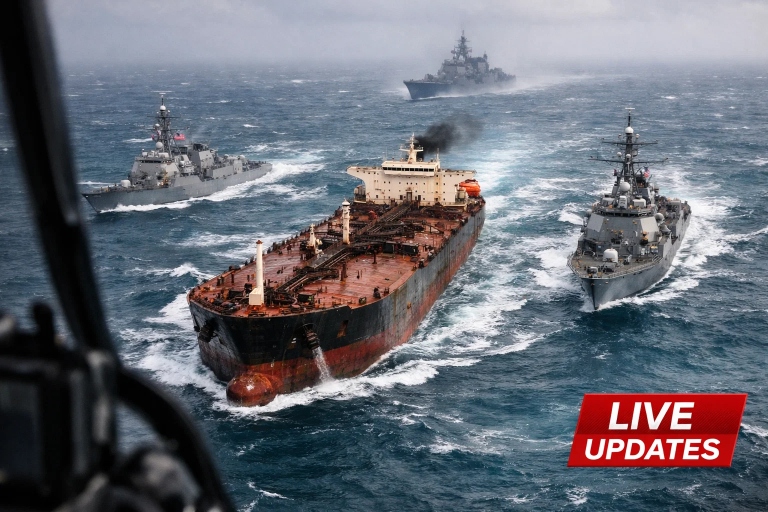

A volatile maritime confrontation has erupted in the Caribbean as a high-speed US Navy tanker chase turns into a geopolitical powder keg. Just days after the capture of Nicolás Maduro, US forces moved to intercept a rogue vessel attempting to smuggle crude oil out of Venezuelan waters. The situation escalated rapidly this afternoon following alarming reports that Russian naval assets are maneuvering to challenge the American blockade. As the US Navy tanker chase unfolds, the world holds its breath, fearing a direct skirmish between two nuclear-armed superpowers on the high seas.
Sailors on Edge: The Caribbean Becomes a Powder Keg
For the merchant marines and local crews navigating these waters, the US Navy tanker chase has turned a trade route into a potential war zone. Distress calls have been reported from civilian vessels trying to clear the area as destroyers cut through the waves at flank speed.
“We can see the gray hulls on the horizon,” said a frightened fisherman from the coastal town of La Guaira. “It feels like the ocean is about to catch fire.” The fear is palpable; this is no longer just a political transition—it is a kinetic military event. Families of the crew aboard the intercepted tanker, The Libertad, are anxiously awaiting word, fearing their loved ones are pawns in a clash of titans.
Coastal Towns Watch in Fear
Residents along the Venezuelan coast are gathering on beaches, not for leisure, but to watch the grim spectacle of war machines maneuvering miles offshore. The rumble of jet engines from nearby carrier strike groups serves as a constant, terrifying soundtrack to their daily lives.
The Scale of Devastation: Naval Assets Deployed
The data coming out of the Pentagon illustrates the severity of this standoff. The US Navy tanker chase is not an isolated police action; it is a massive projection of force meeting resistance. The statistics defining this crisis are staggering:
- 2 US Arleigh Burke-class destroyers are actively flanking the rogue vessel.
- 1 Russian Admiral Gorshkov-class frigate has been tracked within 20 nautical miles.
- 500,000 barrels of crude oil are onboard the fleeing tanker.
- 3 warning shots were reportedly fired across the bow of The Libertad.
This concentration of firepower in such a confined maritime corridor significantly increases the risk of miscalculation. The US Navy tanker chase has effectively shut down commercial shipping lanes, freezing millions of dollars in legitimate trade.
Why Russia is Challenging US Dominance
Analysts are scrambling to understand why Moscow has chosen this moment to intervene. The US Navy tanker chase exposes a deeper geopolitical rift. Russia’s presence is likely a signal that it will not cede its influence in the Western Hemisphere without a fight, even after the fall of its ally, Maduro.
This incident draws eerie parallels to historical Cold War standoffs. By shadowing the US fleet during the US Navy tanker chase, Russia is testing American resolve. It is a dangerous game of “cat and mouse” where the stakes are not just oil, but global prestige and the enforcement of the Monroe Doctrine in the 21st century.
The Shadow of the Cuban Missile Crisis
Historians are already comparing today’s events to the tension of 1962. The proximity of hostile warships to the US mainland during this operation has raised the threat level at Southern Command to its highest point in decades.
What Happens Next: Diplomacy or War?
As night falls over the Caribbean, the US Navy tanker chase continues. Diplomatic channels between Washington and Moscow are reportedly “hot,” with urgent calls attempting to de-escalate the situation before a trigger is pulled.
The US has demanded the immediate surrender of the tanker, while the Russian flotilla maintains a provocative holding pattern. The outcome of this standoff will define the rules of engagement for the new Venezuelan order. If the US Navy tanker chase ends in violence, the conflict could spiral far beyond the coast of South America.
CONCLUSION
This US Navy tanker chase serves as a stark reminder of the fragility of peace during regime changes. What began as an interception of smuggled resources has morphed into an alarming test of global military restraint. As 2 major powers stare each other down over the bow of an oil tanker, the world watches and waits, hoping that diplomacy prevails over the drums of war.