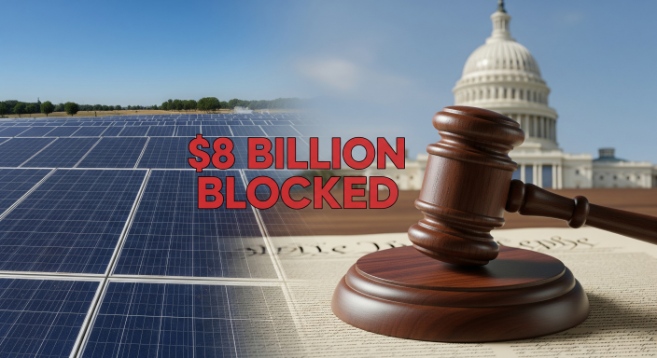

In a stunning legal blow to the White House, a federal judge rules Trump violated the Constitution by weaponizing federal funding against his political opponents. US District Judge Amit Mehta issued a scathing decision on Monday, declaring that the administration’s move to rescind approximately $8 billion in clean energy grants was not a matter of fiscal policy, but an unconstitutional act of retribution. The ruling asserts that the cuts, which exclusively targeted states that voted for Kamala Harris in the 2024 election, breached the Fifth Amendment’s guarantee of equal protection.
States Reel from Loss: Clean Energy Projects Halted
For communities across the affected states, this legal battle is not abstract; it is a fight for economic survival.
- “We aren’t just losing numbers on a spreadsheet; we are losing our future,” said one local official from a targeted district.
- The funding freeze has already stalled construction on hydrogen hubs and renewable infrastructure, leaving thousands of contractors in limbo.
- Residents in these “blue states” have grappled with the realization that their federal government effectively penalized them for their vote, treating them as second-class citizens in the allocation of national resources.
Blue States Targeted Specifically
The court found that the administration didn’t just cut spending across the board. Instead, the axe fell with surgical precision. Only states that cast their electoral votes for the Democratic candidate saw their duly appropriated funds vanish, while red states remained untouched. This partisan discrimination sat at the heart of the judge’s decision.
The Numbers: $8 Billion in Funding Blocked
The scale of the federal judge rules Trump violated Constitution decision is highlighted by the sheer volume of money involved.
- $7.6 to $8 Billion: The total amount of grant funding rescinded.
- 0: The amount of funding cut from states that voted for Donald Trump.
- 27: The number of Democratic-leaning states impacted by the freeze.
- 100s: The number of specific projects, from solar farms to battery plants, that were put on ice.
The Data Speaks:
“The evidence presented to the court was stark:
- Every single terminated grant belonged to a Democratic-voting state.
- The administration bypassed standard congressional rescission procedures.
- The cuts violated the Impoundment Control Act, which limits a President’s ability to withhold congressionally approved funds.”
A Constitutional Crisis? The Legal Argument
This ruling digs deep into the separation of powers. By refusing to spend money appropriated by Congress, the executive branch effectively tried to rewrite the budget unilaterally. Judge Mehta’s opinion emphasizes that the “power of the purse” belongs to the legislative branch, not the President. The decision reinforces that no administration can use the federal treasury as a tool to punish political dissent.
Judge Mehta’s Stance
Judge Amit Mehta, an appointee of former President Barack Obama, did not mince words. He characterized the administration’s actions as “arbitrary and capricious.” He noted that the Fifth Amendment prevents the federal government from denying equal protection of the laws—a protection that extends to states being treated fairly in the distribution of federal benefits.
What Happens Next: Appeals and Restorations
As the news that a federal judge rules Trump violated Constitution spreads, the focus shifts to the immediate fallout.
- Restoration of Funds: The court has ordered the Department of Energy to immediately process the stalled grants.
- Potential Appeals: The Department of Justice is expected to appeal the ruling, likely pushing the case toward the Supreme Court.
- Political Fallout: The decision provides fresh ammunition for congressional critics who argue the President is overstepping his authority.
- Project Revival: Local agencies are already preparing to restart stalled initiatives, though uncertainty remains until the appeals process concludes.
Conclusion
The declaration that a federal judge rules Trump violated Constitution serves as a historic check on executive power. In a political climate defined by deep divisions, the court has drawn a hard line: political retribution cannot dictate federal spending. As $8 billion in funding begins to flow back to the states, the ruling stands as a reminder that in the eyes of the law, the vote of a citizen in a blue state carries the same weight and rights as one in a red state.