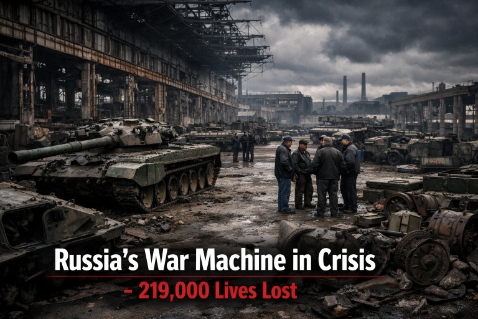

Russia war machine collapse has plunged Vladimir Putin’s regime into unprecedented turmoil, with military and economic foundations crumbling under sustained pressure. Since the 2022 invasion of Ukraine, relentless Ukrainian strikes, Western sanctions, and internal failures have decimated equipment, fuel supplies, and manpower. The Russia war machine, once a symbol of might, now faces shutdowns, debts, and shortages that ripple through society. Families mourn lost loved ones while civilians endure fuel queues and tax hikes. This alarming breakdown not only stalls the battlefield but threatens broader stability, shifting focus to the profound human suffering behind the headlines.
Lives Shattered: Russia War Machine Leaves Families in Ruins
The Russia war machine collapse has exacted a devastating human toll, with over 219,000 soldiers—mostly working-age men—killed in Ukraine, according to estimates from BBC and Mediazona. Families in single-industry towns like Tula and Nizhny Novgorod grapple with grief, as drafted skilled workers vanish forever, leaving voids in homes and communities. One story echoes many: a Kronstadt engineer mobilized and lost in combat, his widow facing financial ruin amid unpaid debts and delayed pensions. Communities rally with makeshift support groups, but the brain drain exacerbates unemployment, forcing migrations and straining social services. This crisis isn’t just strategic—it’s deeply personal, fracturing lives across Russia.
Children and Elderly Most Vulnerable
In regions dependent on defense plants, children face uncertain futures as parents’ deaths or job losses disrupt education and healthcare. Elderly residents, comprising 18% of the population and projected to reach 24% by mid-century, bear the brunt of service cuts, with inflation eroding fixed incomes amid war-driven shortages.
The Scale of Devastation: 219,000 Lives Lost
The Russia war machine collapse has reached catastrophic proportions, with verified data painting a grim picture of systemic failure:
- Over 219,000 confirmed soldier deaths, withdrawing hundreds of thousands more due to injuries and depleting the workforce by 0.5%.
- More than 22,000 military units destroyed or unaccounted for since February 2022, per initial reports.
- A 2.2 million worker shortage across industries, with 70% of businesses reporting deficits.
- Economic slowdown to just 1.1% GDP growth in the first seven months of 2025, down from 4.1% in 2024.
- Military spending ballooning to 40% of the federal budget, or 8% of GDP, yet set to plateau in 2026 amid fiscal strains. These statistics underscore how sanctions and Ukrainian strikes have strangled production, from tank factories like Uralvagonzavod cutting staff to fuel depots ablaze since August 2025.
Climate Change Fingerprints on Russia’s Disaster
The Russia war machine collapse exposes profound vulnerabilities rooted in historical and structural flaws, amplified by global pressures. Since the Soviet Union’s 1991 fall, the defense sector has never faced such a multi-faceted assault: Western sanctions severing supply chains, causing costs to surge “tens to a hundred times” for critical components. Ukrainian long-range strikes on refineries and depots have triggered fuel crises, with shortages forcing hours-long queues and a projected $100 billion budget deficit in 2026. Experts warn this mirrors past imperial overreaches, like World War I resource exhaustion, where one side simply runs dry. Russia’s reliance on inferior imports from China and Iran fails to bridge gaps, while export markets evaporate—multi-billion deals with Egypt and India canceled. This recurring crisis highlights policy failures in modernization, leaving the war economy overheated yet brittle.
Deforestation Increases Flood Risk
Rapid urbanization and war-driven resource extraction have stripped natural buffers, but in Russia’s case, it’s metaphorical: unchecked mobilization has “deforested” the skilled labor pool, amplifying risks as older workers struggle with outdated systems and lost expertise.
From Crisis to Resilience: Russia’s Path Forward
Amid the Russia war machine collapse, recovery efforts are underway, though challenges persist. The Kremlin pledges subsidies and procurement reforms under Defense Minister Andrei Belousov, aiming to integrate smaller firms and dual-use tech for sustainable growth. International aid remains limited due to isolation, but domestic rallies in affected towns show community resilience, with veterans’ programs offering retraining. Long-term strategies include tax hikes—like VAT to 22%—to fund rebuilding, potentially generating $14.3 billion, and diversifying from oil (dropping to 20% of revenues by 2026). Experts urge infrastructure upgrades and diplomatic shifts to avert escalation, emphasizing that sustained Western pressure could force Putin to reassess. As regions like Yekaterinburg rebuild, stories of adaptation inspire hope for a more balanced future.
CONCLUSION
The Russia war machine collapse marks a pivotal moment, blending staggering losses with enduring human spirit amid Putin’s alarming crisis. With over 219,000 lives lost and economic foundations eroding, this Russia war machine breakdown demands reflection on war’s true cost—families torn, communities strained, and a nation at a crossroads. Yet, resilience emerges through community support and policy pivots. As global eyes watch, raising awareness of these vulnerabilities could hasten peace, urging leaders to prioritize people over power. In the end, true strength lies not in machinery, but in unity and adaptation.