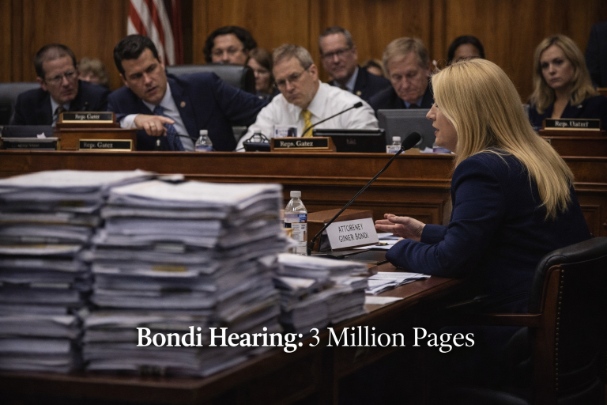

The Bondi hearing before the House Judiciary Committee on Feb. 11, 2026 became an explosive, tightly contested session focused on the Justice Department’s handling of the Jeffrey Epstein files. The Bondi hearing spotlighted the release of more than 3 million pages of documents that critics say violated survivors’ privacy and obscured accountability. As questions mounted about transparency and leadership, the Bondi hearing quickly shifted from routine oversight to raw political confrontation, underscoring deep fractures in Congress and among the public over the DOJ’s direction.
Epstein Survivors and Lawmakers Clash at Bondi Hearing
At the center of the Bondi hearing were voices that rarely take the witness stand — survivors of Jeffrey Epstein’s crimes seated just steps from Attorney General Pam Bondi during testimony. Their presence added a visceral human dimension to an already tense political event.
Democratic members repeatedly pressed Bondi on why the DOJ released files containing personal information about victims while heavy redactions hid names of potentially powerful associates. Some witnesses and lawmakers called the disclosures “sloppy” and “painful,” arguing the department failed to honor both legal obligations and victim privacy.
Several lawmakers urged Bondi to directly apologize to survivors — a request she declined, instead deflecting to broader critiques of prior administrations.
House Judiciary Committee Deepens Scrutiny
Throughout the Bondi hearing, Republicans and Democrats alike voiced frustration with the DOJ’s communication and document handling. Even some Republican lawmakers, traditionally aligned with the attorney general’s party, questioned the choices around redaction practices and transparency compliance.
The committee’s sharp questioning illustrated growing bipartisan concern that the judicial process and oversight mechanisms are being overshadowed by political battles rather than clear accountability.
The Scale of the Controversy: 3 Million Pages Released
Lawmakers at the Bondi hearing hammered home the magnitude of the issue by referencing the sheer volume of material involved:
- 3 million pages: Publicly released Epstein-related files, per DOJ disclosure.
- Multiple redaction disputes: Critics say victims’ identities were exposed, while other names tied to investigations were obscured.
- 5-hour hearing: The session extended for hours amid continuous debate and interruption.
This data underscores not just the quantity of information released, but the intensity of fallout as lawmakers parse through legal compliance, privacy considerations, and political implications.
Why Bondi Hearing Matters: Transparency vs. Partisan Politics
The Bondi hearing did not occur in a vacuum — it is a flashpoint in a larger debate about DOJ transparency, political influence, and accountability.
Democrats accused the Justice Department of mishandling legally mandated disclosures under the Epstein Files Transparency Act, passed to ensure that documents related to Epstein’s crimes would be released with limited redactions.
Republicans at times defended Bondi’s focus on law enforcement priorities, such as declines in violent crime and broader DOJ initiatives. However, even within party lines, frustration emerged over what some called insufficient clarity in how and why redactions were made.
The hearing’s combative tone — with sharp exchanges and aggressive pushbacks — highlighted how deeply politicized oversight of the Justice Department has become, especially under its current leadership.
Political Rhetoric Amplifies Division
Throughout the Bondi hearing, partisan rhetoric frequently overshadowed procedural explanations. Critics described the session as a “circus” or “political theater,” while supporters praised Bondi’s defense of DOJ actions and alignment with broader law enforcement goals.
This dynamic illustrates a broader pattern: oversight mechanisms are increasingly framed through a lens of political loyalty rather than institutional accountability.
What Comes Next: Oversight, Reform, or More Contention?
Looking beyond the Bondi hearing, the path ahead remains uncertain. Lawmakers on both sides of the aisle indicated the process is far from over. Some called for further investigations into document management and redaction standards. Others signaled intentions to pursue legislative or procedural reforms to ensure greater privacy protections for survivors and clearer transparency standards.
The Department of Justice, for its part, insists it complied with legal requirements and is reviewing any sensitive disclosures to correct errors.
Conclusion
The Bondi hearing was more than a congressional session — it was a dramatic contest over trust, transparency, and the role of political influence within the Justice Department. With millions of pages of sensitive material at issue, emotional testimony from survivors, and heated exchanges across party lines, the hearing revealed sharp fractures in how justice and accountability are perceived in Washington. As oversight continues, the public scrutiny and debate sparked by this hearing are likely to reverberate in future discussions about government transparency and institutional integrity.