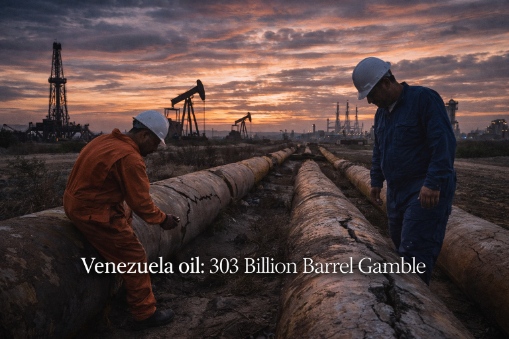

Venezuela oil — a phrase once synonymous with global energy wealth — is now at the heart of one of the most explosive and controversial foreign policy gambles of 2026. With nearly Venezuela oil reserves estimated at 303 billion barrels, U.S. policymakers and private investors see a potential windfall — but the human and geopolitical costs loom large. As this Venezuela oil strategy unfolds, local workers, international partners, and regional powers brace for impact that goes far beyond barrels per day.
Venezuela Oil Workers Face an Uncertain Future
Across the oil fields of Venezuela, the buzz of rigs competes with uncertainty. Venezuela oil was once the backbone of this nation’s economy, but years of mismanagement, corruption, and sanctions left output crippled — now less than a third of its levels two decades ago.
Workers report returning crews to idle facilities in places like Lake Maracaibo, once the heart of Venezuelan drilling. Daily routines that once revolved around production now balance on rumors of foreign investment and uncertainty about legal protections. For many families, the promise of renewed opportunity clashes with fears over continued political instability and the risk of foreign control.
Regional Hubs Like Lake Maracaibo Bear the Brunt
Communities such as those around Lake Maracaibo, historically the epicenter of Venezuela’s oil exports, are witnessing a slow return of activity — but the infrastructure is worn, and many facilities remain damaged or unsafe.
Local residents say that decisions made in Washington and Caracas feel distant from the realities of cracked pipelines and unreliable power. They worry that any revival of Venezuela oil output might benefit foreign corporations more than ordinary Venezuelans.
The Scale of the Prize: 303 Billion Barrels
The Venezuela oil story is, at its core, about scale — and the numbers are staggering:
- ~303 billion barrels: Venezuela’s proven oil reserves — largest in the world.
- <1M barrels/day: Current output far below potential due to decades of decline.
- 30–50 million barrels: Initial sanctioned volumes the U.S. plans to sell under current oversight.
- Decade of investment: Analysts estimate $10 billion per year is needed just to restore capacity.
These figures illustrate both the potential and the challenge: turning dormant wealth into active supply won’t be quick or cheap.
Why Venezuela’s Oil Revival Is Not a Simple Matter
The Venezuela oil conundrum exposes deep structural and geopolitical complexities. Years of underinvestment turned well-head pressure into underperforming pumps. Sanctions regimes, legal battles over expropriated assets, and fractured leadership complicate any straightforward rebound.
Layered atop that are broader geopolitical pressures. China, a long-standing purchaser of Venezuelan crude, sees its interests threatened by U.S. moves and may recalibrate its strategic posture in Latin America.
Experts warn that without robust legal frameworks and clear domestic benefit structures, reopening Venezuela oil to global markets risks sparking contractual disputes, unequal profit splits, and long-term social grievances.
Legacy Infrastructure Challenges Loom Large
Even with access restored, Venezuela’s oil machinery needs massive rehabilitation. Crude pipelines, refining units, and port facilities are decades old or out of service. Restoring them to global-competitive performance could take years and billions in capital commitments.
Next Steps: Recovery, Rebuild, or Rivalries?
The current U.S. administration has signaled that it intends to proceed, framing Venezuela oil access as a win for both Venezuelans and global energy stability. Licensing mechanisms to allow oil exports under U.S. oversight are already in motion.
Yet critics contend that without democratic safeguards and equitable profit sharing, foreign control over such a critical resource may feed corruption and deepen inequality.
Conclusion
The Venezuela oil narrative is at a crossroads — one where economic opportunity intersects with political risk and social consequence. While the 303 billion barrel prize looms large, the path forward is fraught with legal, infrastructural, and human hurdles. Whether this gamble delivers prosperity or fuels further controversy will depend on policy choices made in Caracas, Washington, and global boardrooms — and whether ordinary Venezuelans benefit from a resource that has long defined their nation’s story.